Lookups
Lookups configure dropdown list values used throughout the EPMware application. They provide centralized management of selection lists for properties, user-defined fields, workflow priorities, and other configurable options across all modules.

Lookups configuration screen with search and navigation
Overview
Navigate to Configuration → Misc → Lookups to manage lookup tables that populate dropdown controls throughout EPMware. Lookups consist of:
- Lookup Header - Defines the lookup name and description
- Lookup Codes - Individual values within each lookup
- System Lookups - Seeded, read-only lookups required by EPMware
- Custom Lookups - User-created lookups for business-specific needs
Quick Links
Lookup Structure
Lookup Components
Each lookup consists of two parts:
- Lookup Header
- Name - Unique identifier (no spaces, uppercase recommended)
-
Description - Business-friendly description
-
Lookup Codes
- Enabled - Active/inactive flag
- Lookup Code - Stored value in database
- Meaning - Display value in UI
- Description - Additional context or help text
- Display Seq.# - Sort order for display
Navigation Controls
Use the navigation bar to browse lookups:
- Search by Name - Find lookups by identifier
- Search by Description - Find lookups by description text
- Arrow Buttons - Navigate through lookup records
- Page Controls - Jump to specific pages

Navigation controls for browsing lookups
Creating Lookups
Add New Lookup
- Click the + icon in the header section
- Enter lookup details:

Creating a new lookup header
| Field | Description | Example |
|---|---|---|
| Name | Unique identifier | REQUEST_TYPES |
| Description | Business description | Types of metadata requests |
- Click Save to create the lookup header
Naming Convention
Use UPPER_CASE_WITH_UNDERSCORES for lookup names to maintain consistency and improve readability.
Delete Lookup
- Click the trash icon in the header section
- Confirm deletion
Lookup Dependencies
Ensure the lookup is not referenced in any configuration before deletion. Check: - User Defined Fields - Property configurations - Logic Builder scripts
Lookup Codes
After creating a lookup header, add individual values (codes) that will appear in the dropdown.
Add Lookup Code
- Navigate to or search for the lookup
- Click the + icon in the codes section
- Configure the lookup code:
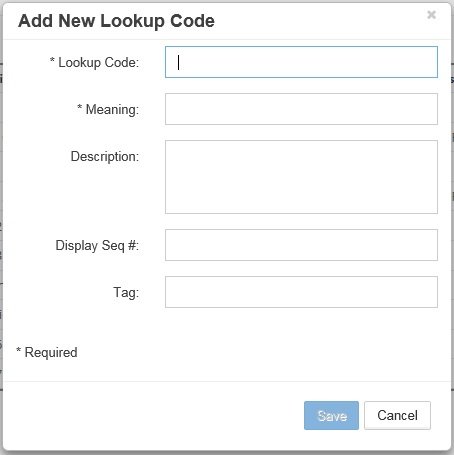
Add New Lookup Code dialog
| Field | Required | Description | Example |
|---|---|---|---|
| Enabled | Yes | Activate/deactivate code | Checked |
| Lookup Code | Yes | Value stored in database | NEW |
| Meaning | Yes | Value displayed to users | New Request |
| Description | No | Additional information | Create new metadata |
| Display Seq.# | Yes | Sort order (lower = first) | 10 |
- Click Save to add the code
Edit Lookup Code
- Right-click on a code row
- Select Properties from menu
- Modify fields as needed
- Click Save to apply changes
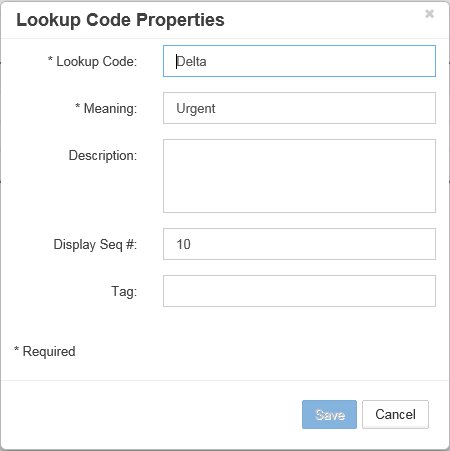
Lookup Code Properties dialog
Delete Lookup Code
- Right-click on a code row
- Select Delete from menu
- Confirm deletion
Single Deletion
Only one lookup code can be deleted at a time.
Managing Display Order
Control the sequence of values in dropdowns using Display Seq.#:
- Values are sorted by Display Seq.# (ascending)
- Use increments of 10 for easy reordering
- Example sequence: 10, 20, 30, 40...
System Lookups
EPMware includes seeded lookups that are essential for system operation. These lookups are read-only and cannot be modified or deleted.

Example of read-only system lookups
Common System Lookups
| Lookup Name | Purpose | Used In |
|---|---|---|
| WORKFLOW_PRIORITY | Request priority levels | Workflows |
| DEPLOYMENT_TYPE | Deployment method options | Deployment Manager |
| VALIDATION_STATUS | Validation result statuses | Request validation |
| TASK_ACTION | Workflow task actions | Workflow Builder |
| USER_TYPE | User authentication types | Security |
| DATA_TYPE | Property data types | Property configuration |
| DISPLAY_TYPE | Property display options | Property configuration |
Read-Only
System lookups are marked as read-only and cannot be edited. They are maintained by EPMware and updated through system upgrades.
Viewing System Lookups
While system lookups cannot be modified, you can: - View their values for reference - Understand available options - Use them in configurations - Reference in Logic Builder scripts
Lookup Usage
User Defined Fields (UDFs)
Lookups are commonly used to populate dropdowns in User Defined Fields:
- Navigate to Configuration → Misc → Global Settings
- Select User Defined Settings tab
- Configure UDF with lookup:
Display Type: Lookup
Lookup: REQUEST_TYPES

Configuring UDF to use a lookup
Property Configuration
Use lookups for member property values:
- Navigate to Configuration → Properties → Configuration
- Set property Display Type to "List of Values"
- Reference lookup in configuration
Logic Builder Integration
Reference lookup values in scripts:
// Check if value exists in lookup
function validateLookupValue(lookupName, value) {
    var sql = `
        SELECT COUNT(*)
        FROM ew_lookups l, ew_lookup_codes c
        WHERE l.lookup_id = c.lookup_id
          AND l.name = :lookupName
          AND c.lookup_code = :value
          AND c.enabled = 'Y'
    `;

    return executeSQL(sql, {lookupName: lookupName, value: value}) > 0;
}
Common Lookup Examples
Example 1: Request Types
Lookup Name: REQUEST_TYPES
Description: Types of metadata change requests
Codes: | Code | Meaning | Description | Seq | |------|---------|-------------|-----| | NEW | New Member | Add new hierarchy member | 10 | | CHANGE | Change Properties | Modify member properties | 20 | | DELETE | Delete Member | Remove from hierarchy | 30 | | MOVE | Move Member | Relocate in hierarchy | 40 |
Example 2: Approval Status
Lookup Name: APPROVAL_STATUS
Description: Request approval status options
Codes: | Code | Meaning | Description | Seq | |------|---------|-------------|-----| | PENDING | Pending Review | Awaiting review | 10 | | APPROVED | Approved | Request approved | 20 | | REJECTED | Rejected | Request rejected | 30 | | HOLD | On Hold | Temporarily paused | 40 |
Example 3: Business Units
Lookup Name: BUSINESS_UNITS
Description: Company business unit codes
Codes: | Code | Meaning | Description | Seq | |------|---------|-------------|-----| | CORP | Corporate | Corporate headquarters | 10 | | NA | North America | NA operations | 20 | | EMEA | Europe, Middle East, Africa | EMEA region | 30 | | APAC | Asia Pacific | APAC region | 40 | | LATAM | Latin America | LATAM region | 50 |
Example 4: Cost Center Types
Lookup Name: COST_CENTER_TYPES
Description: Types of cost centers
Codes: | Code | Meaning | Description | Seq | |------|---------|-------------|-----| | DIRECT | Direct | Direct cost center | 10 | | INDIRECT | Indirect | Indirect/overhead | 20 | | ADMIN | Administrative | Admin support | 30 | | CAPITAL | Capital | Capital projects | 40 |
Best Practices
1. Naming Conventions
- Lookup Names: Use UPPERCASE_WITH_UNDERSCORES
- Descriptive Names: Make purpose clear (e.g., REQUEST_PRIORITY not just PRIORITY)
- Avoid Spaces: Never use spaces in lookup names
- Consistent Prefixes: Group related lookups (e.g., FIN_ACCOUNT_TYPES, FIN_CURRENCIES)
2. Code Management
- Meaningful Codes: Use recognizable abbreviations
- Consistent Format: Maintain consistent code patterns
- Sequence Gaps: Use increments of 10 for flexibility
- Description Usage: Provide helpful descriptions for complex codes
3. Performance
- Limit Size: Keep lookups under 500 values
- Enable/Disable: Use enabled flag instead of deleting
- Optimize Queries: Index lookup tables properly
- Cache Frequently Used: Consider caching static lookups
4. Maintenance
- Document Purpose: Clear descriptions for all lookups
- Regular Review: Audit lookups quarterly
- Archive Unused: Disable rather than delete old codes
- Version Control: Track changes through migration
Integration Points
Where Lookups Are Used
| Module | Usage | Configuration Location |
|---|---|---|
| User Defined Fields | Dropdown values | Global Settings → UDF Settings |
| Property Configuration | Property LOVs | Configuration → Properties |
| Workflow Builder | Priority levels | Workflow → Builder |
| Email Templates | Template selection | Configuration → Email |
| Reports | Filter options | Audit → Reports |
| Logic Builder | Validation lists | Logic Builder scripts |
Dynamic vs. Static Lookups
Static Lookups - Defined in Lookups module: - Fixed set of values - Maintained by administrators - Version controlled - Cached for performance
Dynamic Lookups - Generated via SQL: - Values from queries - Real-time data - Context-sensitive - Used in LOV SQL
Troubleshooting
Common Issues
| Issue | Cause | Solution |
|---|---|---|
| Lookup not appearing in dropdown | Not enabled or wrong name | Verify enabled flag and exact name match |
| Values in wrong order | Display sequence incorrect | Adjust Display Seq.# values |
| Cannot edit lookup | System lookup | System lookups are read-only |
| Duplicate values showing | Multiple enabled codes with same meaning | Check for duplicate enabled codes |
| Lookup deletion fails | Referenced in configuration | Remove all references before deleting |
Validation Queries
Test lookup configuration:
-- Check lookup exists and is active
SELECT l.name, l.description, COUNT(c.lookup_code) code_count
FROM ew_lookups l
LEFT JOIN ew_lookup_codes c ON l.lookup_id = c.lookup_id
WHERE l.name = 'YOUR_LOOKUP_NAME'
  AND c.enabled = 'Y'
GROUP BY l.name, l.description;

-- View all codes for a lookup
SELECT lookup_code, meaning, description, display_seq_num
FROM ew_lookup_codes c
JOIN ew_lookups l ON l.lookup_id = c.lookup_id
WHERE l.name = 'YOUR_LOOKUP_NAME'
  AND c.enabled = 'Y'
ORDER BY display_seq_num;
Migration Considerations
When migrating lookups between environments:
- Export Order:
- Export lookups before configurations that reference them
-
Include both header and codes
-
Dependencies:
- Check UDF configurations
- Verify property configurations
-
Review Logic Builder scripts
-
Environment-Specific:
- Some lookups may be environment-specific
- Document which lookups vary by environment
Related Topics
- User Defined Settings - Configure UDFs with lookups
- Property Configuration - Use lookups in properties
- Logic Builder - Reference lookups in scripts
- Migration - Export/import lookups
- Workflow Builder - Priority lookups in workflows